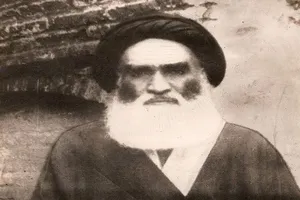
Repudiation of Tobacco concession
Tobacco regie, a contact between Iran's government and English Major Talbot, was considered as a colonial contract and brought transports of rage among Iranian nation. Soon they began a widespread protest which lasted for more than 300 days. Eventually, by Mirza Shirazi's fatwa Qajar government and British colonialsits withdrew. People and clergies together, in May 14, 1981, repudiated the concession of Tobacco. Naser-al-din was so afraid of the impact of fatwa, and he handed a note to Amin-ol-Sultan: "The domestic concession was repudiated few days ago. And we've done so to foreign concession too and everything is back to the way they used to be. Inform all clergies and people and assure them about that".
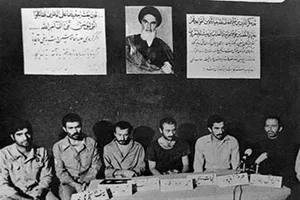
US role in terrorist activities of Forqan groupuscule
After fall of the US embassy in Tehran by Muslim Student Followers of the Imam’s line, documents were found about US supporting Forqan groupuscule.
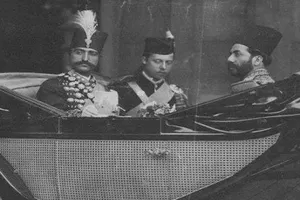
The Protest of Shiite Clerics against the Reuter Agreement
Haj Molla Ali Kani, one of the famous Shiite clerics of Tehran, protested against the Reuter Agreement. He and a number of other Shiite religious leaders resisted against Mirza Hussein Khan Sepahsalar and announced that Sepahsalar is a disbeliever.
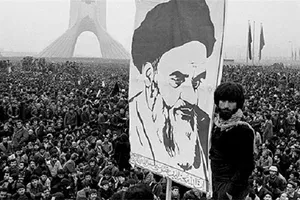
The global reflection of the victory of Islamic revolution
On February 11 the radio announced the victory: "This is the voice of Islamic revolution of Iran". The Pahlavi dynasty was officialy overthrown and the CIA were shocked.
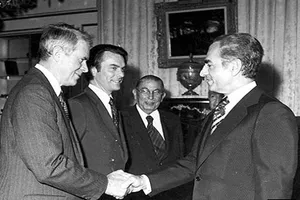
What does US former foreign minister think are the causes for the fall of Pahlavi dynasty?
Cyrus Vance, US foreign minister during the formation and victory of Islamic revolution, mentions the reasons of the fall of Pahlavi dynasty in his diaries: "In my opinion, the fall of Shah was the cross section of conflict between the western modernization and social, economic and religous structures.
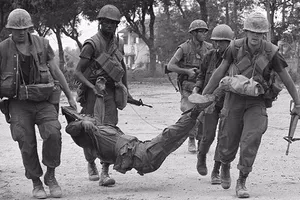
US military presence in Vietnam
In spite of repeated declarations from the official authorities of Washington in 1960, claiming that the United States had not interfered in Vietbam before North Vietnam invaded South Vietnam, America was constantly involved in this unfortunate country in full scale since 1950.
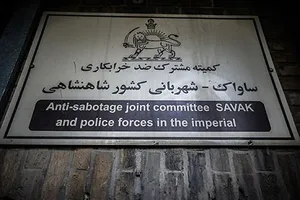
MUSAD during the Islamic Revolution (1977-1978)
From the beginning, the relations between Iran and Israel were faced with oppositions among political-social circles. At the same time with the expansion of the relations between the two countries during the 1960’s and 1970’s, the opposition against...
US interference in Morroco
Ahmed Rami said that Deylami was called to attend Morroco's Royal Palace at 11 PM, January 23, 1983. He was taken to an interrogation room in the basement by ten security agents. At 1 AM, King Hassan arrived with two American officers and they spent a couple of hours there. She was tortured and finally executed by shooting at 5 AM. Then they put his body in his car and took him to suburbs, and they blew the car. No one was allowed to see his corpes, even his own family.
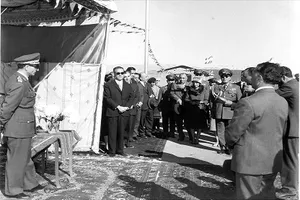
Rouhollah Husseinian
Boycotting the Norouz Festivities
In 1962, remaining tiny bonds of propinquity and relationship between the regime and the clerical institution was unwoven. From one hand, the Shah was determined to suppress the clerics. It was quite clear in his speeches. On the other hand, the leadership of the movement was trying to prepare the students of seminary schools to stand against the regime. In 1962, it was crystal clear that the regime is determined to carry out its decisions. Before 1962, clerics played a passive role in political developments and adopted their stance after the regime’s initiatives. After 1962, however, the leadership of the movement decided to adopt a rather active role in the country’s political developments through its own initiatives in the campaign against the regime.
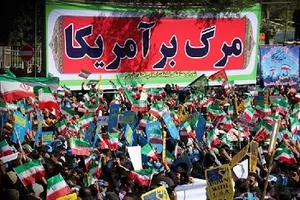
The representation of the other one (USA) as the Great Satan in the discourse of Islamic revolution and Imam Khomeini
the discourse of Imam Khomeini's is identified based on "repelling the threats to Islam, the Muslim world and the Islamic system". In this attitude we face interweaved national and international levels. Imperialism is the enemy, The other one, or the outsider in Imam Khomeini's discourse.